Thursday, June 11, 2015

Madrid

Since we were unable to see the Palacio Real de Madrid on Tuesday, we decided to leave Madrid a little later than planned in order to see it Wednesday morning (June 10).  After we packed up and checked out of our hotel, we walked through the Plaza Mayor to the Palace.  It had rained in the night, so it was not as hot as it had been the previous days.

The Palacio Real, second only to Versailles in size and splendor, is on the site of a former palace of the Spanish Hapsburgs (built over the Moorish fortress of Alcazar), which was destroyed by fire in 1734.  The current palace was completed in 1764, and it continues to be the official residence of the Spanish monarchs, currently King Felipe VI and Queen Letizia.  Unfortunately, I do not have photos of the wonderful rooms of armor, ceremonial halls, antechambers and other rooms of the palace since photography is not allowed, except for inside the main entrance.

Palacio Real de Madrid
We first visited the rooms of the Royal Armory.  In these, there is an impressive array of suits of armor, horse armor and weapons from several centuries.  Most of the suits of armor were for actual battle but a few were more ornate and were used by royalty for processions and other formal occasions.  The exhibits provide a wealth of information on the history of personal armament in Spain.

Before entering the actual palace, we peeked into the Prince's Courtyard where we could see the official and elaborately dressed palace guards.

Palace Guards in the Prince's Courtyard
The palace is entered by climbing the grand staircase that leads from the ground floor to the first level.  The large vaulted ceiling above the two flights of stairs is painted with figures and scenes representing the Triumph of Religion and the Church Protected by the Spanish Monarchy.

Ceiling above the Grand Staircase
Almost all the rooms we visited have painted ceilings, with a few by the famous artist Giovanni Baptista Tiepolo, whom Charles III brought from Italy.  Some rooms have silk coverings on the walls while others are covered with tapestries, including 16th and 17th century Flemish tapestries.  Portraits of many of the monarchs since the late 18th century hang in various rooms.  Royal portraits and other paintings by Velazquez, Goya, Rubens, El Greco and Caravaggi can be found throughout the public rooms.   Floors are made of intricate wood parquet or polished marble, with plush carpets laid out over them.  Heavy, richly colored silk draperies adorn the windows and doorways.  Stunning crystal chandeliers hang in every room.

Particularly enchanting is the Porcelain Room.  The walls and ceilings are entirely covered with lustrous procelain panels attached to a wooden framework underneath.  The pieces are cleverly joined together so that vines and garlands disguise the joints, making it impossible to perceive them.  All the pieces were crafted in the Buen Retiro royal porcelain factory during the reign of Charles III.

The grand banqueting hall is truly enormous.  It was created during the reign of Alfonso XII by removing walls and joining together three large rooms formerly belonging to the apartments of the Queen.  (I assume she was given other accommodations elsewhere in the massive palace.)   Priceless, sixteenth-century Flemish tapestries hang on the walls.  The table, covered in white damask, was set for about 100 people; each place was set with royal china, rows of cutlery on either side and a half dozen goblets of various sizes.  Between each of the elegant chairs there was plenty of room for servers to present dishes to each guest.  Silver candelabra and large arrangements of flowers marched down the center of the long table.  This table took up approximately half of the hall.  The other half is designed to be used for balls.  Hanging from the high ceilings are 15 huge bronze and crystal chandeliers.

Another room, the antechamber of Maria Cristina, displays five instruments crafted for the Spanish court by Antonio Stadivari between 1667 and 1709.  The Crown Room contains not only the official crown and sceptre, but the brilliant gold chain representing the Order of the Golden Fleece (a prestigous and exclusive order established in 1430 by the Duke of Burgundy).  Also displayed in the Crown Room are the offical abdication of King Juan Carlos I and the proclamation speech of King Felipe VI, the current monarch since June 19, 2014.

The final room we visited was the throne room.  Not as large as the banqueting hall, it is lavishly decorated in shades of red and gold and illuminated by Venetian chandeliers of rock crystal and silver.  A magnificent fresco depicting the "Greatness of the Spanish Monarchy" was painted by Tiepolo in 1764, when he was 68 years old.  We were told that the reigning king and queen choose not to wear robes and crowns during official ceremonies in order not to distance themselves from the ordinary people.

Leaving the palace, we wandered through the streets, getting a bit lost at times because of the organic (rather than grid-like) nature of the layout of the city.  We ended up stopping in one church, the Basilica Pontificia de San Miguel and poking around the neighborhood of La Latina.  (The churches and palaces of Spain clearly show one of the main uses of the gold and silver obtained from the
Spanish colonies in America.)

Basilica Pontificia de San Miguel
Eventually, we reached our hotel and retrieved our luggage.  The metro was only half a block away, so getting to the Atocha train station was easy.  I thought there was a train leaving around 3 p.m., so we arrived at 2 in order to book seats and navigate the large station.  However, I apparently was mistaken, and the next train was leaving at 5:30, so we had to wait a few hours.  Luckily, Katya can keep herself amused with books on her Nook.  I finished reading Oliver Twist in Split and am now halfway through War and Peace.  Katya brought that tome to read, but she prefers to re-read lighter novels she has already read before.

We arrived in Granada (by train to Antequera-Santa Ana and then by bus to Granada since RENFE is working on the tracks) around 9:30 and caught a taxi to our hotel, which is in a 16th century palace.  Our room is two stories high, with a large loft.  We explored the surrounding area a bit and then went to bed, ready for the Alhambra on Thursday.

Tuesday, June 9, 2015

Madrid

Katya and I have enjoyed the sunshine and warmth, the architecture, the plazas, the parks and the people of Madrid for the last two days.  Yesterday, Monday, June 8, we slept until after 9 a.m.  After we were ready to go out, we made our first stop the Prado Museum (Museo Nacional del Prado), with its famous collection of European paintings.  We began by viewing works of French, Italian and Spanish painters going back to the mid-16th century.  I enjoyed remembering at least some of what I had learned about art history in college as I went from room to room, observing the development of styles and techniques.  Most of the paintings from this period depict Christian themes, including the Annunciation, the shepherds and wise men visiting the baby Jesus, the crucifixtion, and the lives and martyrdom of saints.  Other canvases were portraits of royalty, and a few were wonderfully realistic still lives.  I particularly appreciated seeing the works of Poussin, Ribera, Zurbaran, Velaxquez, Murillo and El Greco.  I could have spent the whole day at the Prado, but after three hours, Katya was totally bored with "the same type of pictures."  We were both hungry, so we left to spend some time outdoors  and find something to eat.

Usually we pick up food at small groceries or take-out restaurants, but for lunch that day, we chose a nice restaurant near the Parque del Buen Retiro.  Katya had a hamburger and I had a caprese salad.  (We are not very adventurous when it comes to selecting food.) During lunch, we agreed not to return to the Prado, and we spent the rest of the afternoon outside.  A craftsmen's fair is being held now along the Paseo de Recoletos (just north of the Paseo del Prado), featuring jewelers, wood turners, knitters, woodworkers, toy makers, hatters, glass workers, ceramists and leather workers.  We strolled past all their displays.  Although there were many attractive, creative and well-made items, we couldn't settle on anything to buy.  

Our next destination was the Parque del Buen Retiro.  We came upon a large, rectangular body of water, the Estanque, where ducks were swimming and people were out in boats enjoying the hot day.

Estanque
Walking past the lake, we saw a large brick building with exterior tile decorations, the Palacio de Velazquez, an exhibition hall.  Inside the vast, white interior was an exhibition called Sculpture in Place, 1958-2010, featuring the work of American artist Carl Andre, a noted Minimalist.  While I appreciated the exploration of texture and spacial relationships with large geometric pieces of wood, stone or metal arranged across the expanse of the white floor, Katya was less than impressed.  We both agreed that it would be more fun if we could interact with the artwork, i.e., sit, lie or walk on it.

Palacio de Velazquez 
Sculpture in Place
Near the Palacio de Velazquez is the Palacio de Cristal, a spacious glass structure that looks like a traditional conservatory for plants. Also used as an exhibition space, this building housed one large piece by Federico Guzman entitled "Tuiza:  The Cultures of the Bedouin Tent."  In the Hassaniya Arabic dialect of the African Bidan, "tuiza" refers to work that is carried out in collective solidarity, constructing something with everyone's involvement.  The great tent inside the Palacio de Cristal, with its bright colors, patterned rugs and soft cushions invited everyone who enters to relax and appreciate the play of light and the sound of the birds outside.  Katya chose to lie down and half-nap while I wandered around inside, admiring the interplay of light, color and design in the translucent tent walls and the floor coverings and the juxtapostion of the side and ceiling panels of cloth.  It was a delightful place to relax.

Tuizo installation
Katya relaxing 
Palacio de Cristal
In front of the Palacio de Cristal is a large pond with ducks and fish and turtles swimming in the green water, dotted with swamp cypress. The steps down to this pond were also a nice place to spend a few minutes, enjoying nature within a large and traffic-filled city.

We both needed something cold, so we found a food vendor in the park.  I just wanted a drink, but Katya ordered an ice cream cone. The man asked for six euros.  I handed him a five and then looked in my wallet for a one euro coin.  Not finding one, I gave him a ten euro note.  However, he did not return the five euro note, so he had 15 euros from me.  The cost was six euros, and he gave me four euros in change.  I told him, in my inadequate Spanish, that I had given him 15 and he owed me 9.  He began to argue with me, with me insisting on cinco and diez and him insisting I had given him cinco and cinco.  Finally, I asked if anyone spoke any English.  One woman who worked there did.  I explained in English what had happened.  She understood me but could not speak English well.  Meanwhile, the man was continuing to gesticulate and loudly insist that I had only given him 10 euros.  Katya and I were sure that this was not true, particularly because Spanish currency comes in different colors, and we both noted that one note I gave him was pink and the other blue.  My Spanish was good enough to ask them to summon the police to resolve the problem.  By then, however, I think the woman understood that we were correct and ordered the man to give us back five euros.  It was quite a lively experience!

We had walked a lot and were hot, so we decided to go back to our hotel room for a while to have an afternoon rest as the Spanish do and then go out on the streets later in the evening.  This we did.  When we exited our hotel around 10 p.m., we saw, walking in single file, a number of African men with large white bundles on their backs.  This seemed curious to us, but we had no explanation.  We went to Plaza Mayor, but not much was happening there although a lot of people were out.  We strolled over to the Puerto del Sol, where it was more lively.  In the center, a group of young men on roller blades were performing stunts for a crowd gathered around them.  We stopped to watch them maneuver around cones and jump over a row of volunteers from the audience who were lying side by side on their backs.

We bought some food to eat and continued to stroll around the square.  Soon, it became clear to us what the black men with white bundles were doing.  They were making there way to Puerto del Sol.  Inside their bundles were either hats, purses, fans, clothing or other types of merchandise.  When they dropped the bundles on the pavement, they opened up into large, rectangular pieces of cloth about the size of bedsheets.  A continuous cord was strung inside a seam along the perimeter of the white cloth, with four connected cords running from each corner to meet above the center of the cloth so that the sheet made the bottom of a four-sided pyramid and the loose cords connected in the middle created the vertices of the four non-existent faces.  The men held on to or kept within reach the center where they all came together (the peak of the pyramid).  About a dozen of these men had just set up shop in a row along the side of the plaza when a police car approached, heading straight for them from one end.  With a quick flick on their wrists, the merchandise displays became non-descript bundles in a flash.  Obviously, this avoidance of the police was just for show, however, as they immediately put out their wares again, in the blink of an eye, after the cruiser turned a corner.  We figured that either they (1) are not licensed to sell on the streets; (2) are selling stolen goods; or (3) are illegal immigrants.  Perhaps all three apply.  They did not seem happy when I snapped a photo!  We quickly exited the plaza and returned to the safety and quiet of our hotel.

Illegal vendors, Puerta del Sol
This morning, Tuesday, June 9, our plan was to visit the Palacio Real de Madrid first.  We stopped along the busy Calle Colegiata to look in shops.  One fascinating place was a store where people ordered belts made to their specifications.  In the shop window and inside, there was a vast array of belt buckles, ornaments and leather.  There were several customers, each being individually attended to by a craftsman.  This was something neither of us had ever seen before.

Before reaching the palace, we stopped in a supermarket for breakfast on the run as well as two churches.  The first was the Iglesia Catedral de las Fuerzas Armadas de Espana.  Fairly non-descript on the outside, it is filled with Baroque altars gilded in glistening gold, frescoes and paintings.

This lovely little church stands in stark contrast to the nearby enormous Cathedral de Santa Maria la Real de La Almudena, the seat of the Roman Catholic archdiocese of Madrid.  Soaring columns support vaulted ceiling painted in vibrant geometric designs.  Modern stained glass windows create prisms of lights on the marble floors.  Although construction of the current cathedral began in the late 19th century, it was only completed a couple decades ago, consecrated in 1993.  Particularly outstanding is an elevated altar to Santa Maria de La Almudena, with its gold statue, silver angels and stunning paintings framed in gold.  The size and the vibrant colors of this cathedral are awe-inspiring.

Santa Maria de La Almudena
Vibrant colors in the Neo-Gothic Cathedral of Madrid
Past the Cathedral is the Palacio Real de Madrid.  We were disappointed to find that it was closed for the day because of some official event.  We will return on Wednesday.  We had planned to stay at the palace for a couple hours and then go to the Sorolla Museum.  With time to kill, we decided not to take the metro but to walk there, even though it was a few miles.  This allowed us to see the bustling shopping area of the Called Gran Via, where we poked into a few shops.  This brought us again to the Plaza de Cibeles and the craft vendors along the Paseo de Recoletos, where we had been the previous day.  The Paseo de Recoletos turned into the Paseo de la Castellana as we continued north.  When we reached the Ruben Dario metro stop, which I knew was near the museum, I asked for and understood directions in Spanish!

Only a few blocks away (derecho and then izquierda), we found the museum, the former home of the famous Spanish painter Joaquin Sorolla.  I was not familiar with his work, but the museum has good reviews, and we were not disappointed.  We entered through a lovely garden with water features, Spanish tile work and carefully shaped shrubbery.  His former home includes three gallery rooms of his paintings, some of the family's living space, including the living and dining rooms (which he designed) and another exhibition space with sketches in charcoal and pencil alongside finished paintings, showing the progression of his work from studies to final products.  Most of his paintings are of his family, gardens or the seashore, done in an Impressionistic manner (one of my favorite styles).

Sorolla's studio
Sorolla's studio
mantle in the dining room of Sorolla's house
We were too exhausted to walk back to the center of the city, so we took the metro.  Katya wanted potstickers again, so we searched out the small Chinese restaurant.  It was after 4 p.m., and the staf was getting ready to close for the afternoon (in order to re-open for business later when the Spanish natives eat), so we got take-out and ate it at the nearby Paseo del Prado.

The only thing left on our agenda for the day was a visit to an exhibition of origami at the Imprenta Municipal-Artes del Libro on Calle Concepcion Jeronima.  I knew that this street was between Tirso de Molina and Puerta del Sol, so we thought we would be able to find it on the way back to the hotel. We followed several streets and even asked directions, but when we got to Puerta del Sol, only a few blocks from our hotel, we gave up.  At the top end of the short street where our hotel is located, we found the Calle Concepcion Jeronima!  It intersects!  And we had walked right by the museum when we left the hotel in the morning.

The origami exhibition is a temporary installation featuring intricate pieces from artists from around the world.  It was really worth finding.  On the ground floor of the museum is a permanent exhibit on the history of printing and book-making.  This also was fascinating, although my understanding of all the exhibits was limited since all the explanations were only in Spanish.  I was amazed at the variety of printing presses on display as well as the beauty of some early leather-found volumes.

And so, we ended our day and spent the evening resting in the hotel.  I have caught up with my blogging.  Tomorrow we will visit the Palacia Real de Madrid before catching a train to Granada.

Buenes noches!

Monday, June 8, 2015

Salzburg, Visiting the Blanchards, Avignon and Now Madrid!

It's now Monday, June 8, and I am terribly behind on this blog.  I last wrote from Graz, a place where we wished we could have stayed longer.  However, this trip is like a sampler of Europe, and we keep moving on.  We are staying three nights in Madrid, so we don't have to unpack and pack up again every day!  As soon as Katya is ready, we will be leaving the hotel for the Prado Museum and the street life of Madrid.  However, I will get a start on this installment and add to it later.

As the train travelled through the Austrian countryside, we were able to have great views of fields, copses, forests and villages, with a rich variety of shades of green everywhere.  Rain seems to have been abundant in Europe (as opposed to California!)

Austrian countryside from the train
We arrived in Salzburg before midday on Tuesday, June 2, and made our way on foot to the old part of the city, south of the Salzach River, and our hotel, the Hotel Goldgasse, where we left our luggage.  We then set out to find food because we were hungry.  Using another bridge, we crossed the river again and walked to the Mirabell Gardens, but we couldn't find anything that appealed to both of us.  (Making decisions seems more difficult when we are hungry.)  We crossed the river yet again via another, pedestrian bridge, found a grocery store and bought some food to eat in the park.  In the park, sitting in the shade, for it was already getting quite warm, we enjoyed our lunch and were re-energized.

We then spent some time walking through the formal Mirabell Gardens.  The view from the far end, out over the gardens toward the old city and the fortress on the hill behind it is wonderful.  The formal rose garden was in full bloom, with mostly velvety red flowers accentuated by yellow and orange varieties.
Mirabell Gardens with churches and Festung Hohensalzburg fortress behind
Katya in Mirabell Gardens

After strolling through the gardens, we rambled around the streets on the north side of the river, stopping in churches and cemeteries.  (At one convent church, we had great difficulty opening the heavy door to exit and feared we were trapped in monastic life!)  The cemetery of Saint Sebastianskirche contains the graves of Mozart's father and wife.  In the center is the ochre-colored Gabriel Chapel, the mausoleum of Prince Archbishop Wolf Dietrich.  A powerful figure in Austrian history, he had the Mirabell Palace and Gardens constructed (for his mistress) and commissioned the plans for the Salzburg Residenz (which was the home of the bishops for centuries), the adjacent Residenzplatz, and the reconstruction of the cathedral after the original structure was destroyed by fire in 1598.

Mausaleum of Wolf Dietrich
(Katya is ready, so much more will have to be added to this later.  We are alive and well, in case anyone was wondering!)

******

(We are back at the hotel resting after exploring some of Madrid, so I will continue where I left off.)

******
Katya enjoying another ice cream cone
After exploring some of the streets on the northeast bank of the river, we went back to the old city (Altstadt)  and our hotel.  The hostess was exuberant and helpful and showed us to our beautiful, large room, furnished with new and modern fixtures but reflecting old world charm in the delicately painted scenes and borders of the ceiling.  There was a box of goodies including delicious chocolate as well as free drinks in the ultra-modern red refrigerator.

We relaxed for a short while and then set out to explore more of Salzburg.  Our hotel was only a very short distance from one of the main squares, the Residenzplatz.  We strolled across it and entered the Baroque Salzburg Dom (Cathedral), a majestic structure in early Baroque style.  Above the entrance are three years:  774, 1628 and 1959.  In 774, Abbot and Bishop Virgil from Ireland consecrated the first cathedral on the site.  This burned in 1598.  Thirty years later, the new and grander Baroque structure commissioned by Wolf Dietrich was consecrated in 1628.  During WWII, an aerial bomb destroyed the dome of the cathedral.  After 15 years, the cathedral was re-opened for Roman Catholic services.

Interior of the dome of Salzburg Cathedral
In front of the church is the Domplatz, dominated by the large Maria Immaculata column.  Unlike figures of Mary found on other columns in front of many European cathedrals, the figure of Mary in Salzburg faces away from the facade.  When one stands at the far end of Domplatz facing the column and the cathedral behind it, it appears that the two angels holding a golden crown on the front of the church are placing the crown directly on the head of Mary.

Our next stop was the Franziskanerkirche (Franciscan Church), one of the oldest church structures in Salzburg.  Architecturally Gothic, the interior was redesigned in the 18th century.  The loftiness of the gothic arches draws the eye more, I think, than the Baroque ornamentation.

Altar in the apse of Franziskanerkirche
From that church, we climbed up winding streets to reach the Festung Hohensalzburg, the fortress atop the steep, forested hillside towering behind the old city.  This massive fortress and its castle withstood attempted sieges and was never overcome by enemies.  It is considered the largest preserved medieval fortress in Europe.  Unfortunately, because of our limited stay in Salzburg, we did not have time to explore the interior of the fortress and the castle.  However, the views of Salzburg from the hill are impressive.

Festung Hohensalzburg
View from Festung Hohensalzburg
Getriedegasse
Returning to the old city by another winding route, we walked around a bit and settled on a little cafe for dinner.  After our meal, we strolled over to Getreidegasse, the most famous historical street in Salzburg.  The narrow street--lined on both sides by narrow, tall houses interspersed with courtyards and little alleys--has for centuries been a shopping area.  Hanging above the storefronts still are medieval wrought-iron guild signs.

Back in our hotel room, we enjoyed the lovely ambiance and fell to sleep quickly, as we have almost every night, filled with vivid impressions from the day.

The next morning, Wednesday, June 3, we reluctantly departed from Salzburg and caught a train at 8 a.m. to Frankfurt, transferring to another train to Liege, Belgium, in order to take a third train to Verviers, where our former Rotary Exchange student Sam and his mother Domi met us at the station in the late afternoon.  They took us to their lovely home in the small village of Xhendelesse in the Pays de Herve.  Fortunately for us, Domi is fairly fluent in English, as are all of the Blanchard children.  Her husband, Francis, understands English and, despite his denial of his abilities, speaks well also when he chooses.  Francis, a general practitioner, has his office in a building in front of the house, and he joined us when his work day was over.  Sam's oldest brother, Lionel, also lives at home, and he arrived home from Liege a bit later.  We all enjoyed great conversation and food.

Sam is in the middle of semester exams at school, so he was not available the next day, Thursday, June 4.  Katya and I slept until almost noon (although we had intended to get up earlier).  After eating some fresh, delicious crepes which Domi had made for us, Domi, Katya and I left for an afternoon of exploration.  First we went to La Fagne, a natural area in southern Belgium and northern France close to their home.  (The name is from the local Walloon language and translates into English as "fen" or marshy ground.)  From a viewing tower, we could see the surrounding countryside, fields and villages.

After our short walk in this natural area, we drove into the town of Spa, a town famous since at least the 14th century for its cold mineral springs.  We stopped in a jewelry shop owned by a friend of Domi's.  While passing by a cafe, Domi noticed her cousin and her cousin's husband sitting at a table, so we stopped to talk with them.  While there, a man came up behind Domi and tapped her on the shoulder; it was her daughter Celene's partner, Sam, who was in the town for business.  (To avoid confusion, the family calls him "Big Sam" and our Sam "Little Sam.")  After that, we did some shopping to select a present for Emilie, Little Sam's new girlfriend, since she would be with us at dinner that evening and it was her birthday.
Formal gardens in Spa
Since we had enough time, we went back to the Blanchard's home to meet up with everyone in order to go out to a nice restaurant in the town of Aubel.  There were eight of us:  Domi and Francis, Sam and Emily, Sam's good friend Sofia (whom we had met briefly the night before), Lionel and Katya and me.  The food was excellent, and we all had a great time eating outside and enjoying the warm weather and companionship.  People who knew the Blanchards came to chat with us; they seem to know people everywhere!

Lionel, Katya, Sherri, Sofian, Sam, Emilie, Domi and Francis at a restaurant in Aubel
The next day, Friday, June 5, Francis had arranged to take the day off from his practice to join us in exploring the area.  Our first stop was the city of Maastricht in the southeast part of the Netherlands, one of the oldest cities in the country.  It is famous for its Friday market.  We arrived at the market square after wandering along streets and alleys, passing by an old but still operational water wheel powering a flour mill formerly used by a religious order.

Water wheel in Maatstricht
The market was colorful and bustling, with vendors selling fruits and vegetables, meat, prepared food, textiles, leather goods and many other items.  Since the whole family would be together at the house that evening, Domi and Francis were shopping for food to serve as well as food for lunch in the park.  In addition to vegetables, they purchased ready-to-fry calamari and chicken nuggets.  Indoors in the shopping center, following advise from an outside vendor, we found a shop selling Turkish food and purchased a wide variety of items including mildly spicy rolls made with red lentils, avocado dip, and hummus.

After our shopping, we stopped at an outdoor cafe for refreshments, which seems to be something Europeans do much more than Americans.  We walked to the Meuse River, from which we could see some of the ancient fortifications of the city, and then to a park to eat our sandwiches and other food.

Maatstricht
*****

(Time for Katya and I to venture out onto the streets of Madrid to enjoy the nightlife and find a bit of food.  To be continued. . . .)

*****

With the Blanchards, our next stop was Vaalserberg, the highest point in the Netherlands and also the place where the borders of the Netherlands, Belgium and Germany meet.  We went to the top of a tower for a panoramic view of the area.

View from the Tri-Border tower
After that, we stopped at the Henri-Chappelle American Cemetery and Memorial outside of Hombourg, Belgium, where 7987 American soldiers who died in two campaigns during WWII are buried.  The first soldiers were buried here in September 1944, after the U.S. First Infantry liberated the area.  The subsequent battles in which buried soldiers lost their lives included the Battle of the Bulge in the Ardennes (the Ardennes Counteroffensive), in which the United States incurred the greatest number of casualites during the war.  In this battle, my great uncle Bydie (William) Long, my maternal grandma's brother, was killed.  (He is not buried at Henri-Chappelle; his remains were returned to the States and he is buried with the family in the cemetery in New Cumberland, WV.)  The rows of white crosses spread across the vendant, green grass behind a tall column with a bronze statue of the Angel of Peace atop.

Henri-Chapelle American Cemetery
After some quiet moments at the cemetery, we continued on to the Abbaye du Val Dieu (Abbey of the  Valley of God), a former Cisterecian monastery in the Pays de Herve.  Still occupied by a Christian community (though not monks), the abbey brews its namesake beer in the tradition of the monks.  Francis and I took the opportunity to have a glass!  After our refreshments, we went into the abbey's church, where a pianist was practicing for a concert later that evening.

Stained glass windows in the church at Abbaye du Val Dieu
After our day of sight-seeing, we went back to Xhendelesse.  With the food that had been purchased in Maastricht, Domi and Francis and other members of the family spread out a feast of hors d'ouerves on the patio of their home.  The weather, which had been unusually warm, was becoming cooler as a rainstorm approached the region, and Katya and I had the opportunity to enjoy an hour or two of companionship with all six Blanchards--Domi, Francis, Celene, Lionel, Antoinne and Sam--plus Big Sam and Antoinne's girlfriend Helene.  (Emilie had already left earlier that day.)  With the abundance of food, dinner was not necessary.  After cleaning up, Domi, Katya and I set out on a walk around the village (It had not started to rain yet.) and were joined after a few minutes by Francis and Lionel.  During our stroll, I learned from Lionel about the various levels of government from Lionel, who is an elected official as well as a government employee.

Big Sam, Antoinne, Lionel, Celene, Helene, Sam, Francis and Domi
Because most of Europe is much farther north than central California, the days are much longer in the summer.  Katya and I have often been surprised to discover that it is 9 or 10 p.m. when it seems much earlier in the evening to us because of the height of the sun in the western sky.  This was the case that evening, so it was time for bed when we returned.

The next morning, Saturday, June 6, we arose around 6 a.m. in order to continue on our journey to our next stop, Avignon, France.  Unfortunately, I neglected to make reservations in advance for the TGV from Brussels to Avignon, and at the station in Verviers I learned that all seats were taken.  Nonetheless, Katya and I boarded the early morning train for Brussels and figured we would work out plans once we arrived there.

At the large Brussels-Midi station, we found our way to the international ticketing office and were able to book seats on a train to Paris Gare de Nord and seats on a TGV from Paris Gare de Lyon to Avignon, scheduled to arrive only a couple hours after I had intended.  However, this meant that we had to navigate our way from one station in Paris to another using the Metro, which I had hoped to avoid.  In reality, it was not as much trouble as I anticipated, and our journey went smoothly.

Katya sleeping on a train
Our hotel, which was not one of our favorites (and there have been some which we absolutely loved), was in the city walls of Avignon, within easy walking distance from the station.  Because we arrived later than anticipated, however, we did not have time to go inside the Palais des Papes (the Palace of the Popes) or any museums.  We stopped to sit down for dinner in the park above the cathedral.

Palais des Papes
As usual, we strolled around the streets and walked on a bridge across the Rhone.  From the undeveloped banks on that side, we had wonderful views of the old walled city and the remains of the Pont Saint Benezet, originally constructed in the 13th century using 22 stone arches.  Several times over the ensuing centuries, flooding of the Rhone River damaged the bridge, and after the 17th century, attempts at reconstruction were abandoned, leaving a romantic piece of medieval architecture jutting out over the water, with only four arches remaining.

Pont Saint Benezet and the Palais des Papes from the banks of the Rhone
We did not find Avignon to be as charming as the cities we visited in the Czech Republic, Hungary, Croatia, Austria, Belgium and the Netherlands, and we were surprised at the amount of litter not only in the streets but on the walls and around other structures that are designated UNESCO World Heritage Sites.  That and the fact that our hotel room on the ground floor was musty, with flies and mosquitoes and only intermittent Internet service (although the beds were comfortable and the room was clean), made us not too sorry that we had so little time in Avignon.

We arose later than we should have.  Walking as fast as we could to the train station, we still missed the 7:52 a.m. shuttle train from Avignon Central to the Avignon TGV station 5 minutes away.  There was a train in the station which we thought might be it, so we hurried down the stairs, went under the tracks, and panted up the steps to the platform.  We boarded the train, but there was no one else around or on board and there was no destination listed on the car or the platform sign.  After the time passed 8:00 a.m., we were sure that it was not the right train and rushed back down, across and up to the station.  Someone was then available in the information booth; he told us that the next train would leave from the furthest track.  We trudged back down, across and up to that platform.  The train had not arrived (The train we had mistaken for ours was still sitting on the next tracks.), so I rushed back over to the station and bought croissants and Coke Light for breakfast.  (Choices were limited!)  The next train was scheduled for 8:27, so I was quite anxious that we would not make it in time to board our 8:40 TGV train to Madrid.  I went to information again to get exact information about what platform we would be arriving at and what platform the TGV would be departing because I did not think we'd have the time to find signs and directions.  After the panic, things went smoothly; we arrived at the TGV station and had plenty of time (minutes to spare!) to get to our place on the platform for our car on the train.

The train passed farm fields, some castles and ruins on hills, small villages and marshes before getting to the drier planes of northern Spain.  When we arrived in Madrid, wielding my limited fluency in the Spanish language, I was able to get instructions on how to catch the Metro to a stop near our hotel and how to get to from the stop to the hotel.  (Unlike the time we were in Puerto Rico, I now understand the difference between "derecho" and "derecha" so I can follow directions!)

Our hotel is a basic but clean and comfortable place just south of Plaza del Sol and east of Plaza Mayor.  After checking in, we set out to explore.  First, we walked to Plaza Mayor, a enormous retangular space surrounded by earth-toned, three-story residential buildings with hundreds of balconies, constructed in the late 17th century.  Now it abounds with outdoor cafes and shops along its perimeter and hundreds of people strolling and relaxing.  In the past, it was the sight of bullfights, markets, religious celebrations and public executions, including the "autos de fe" of the Spanish Inquisition, which were enormous public spectacles.

Plaza Mayor in Madrid
From the Plaza Mayor, we walked to the Puerto del Sol, a few blocks away (but not along straight streets arranged in a grid), admiring the various architectural styles of the facades.  This large plaza was also teeming with tourists and locals enjoying the warmth of a summer Sunday afternoon.  We stopped to eat; I had a piece of pizza, Katya had a donut.  (Our good dietary habits have been neglected while traveling.)  Obviously still hungry, we stopped at a small Chinese restaurant along the Calle del Huertos, where we enjoyed nutritious vegetables and noodles and Katya ate a large portion of potstickers.

balconies of Madrid
Our final stop of the day was the Real Jardin Botanico (Royal Botanical Garden).  The garden dates from the late 18th century.  Not only a peaceful place for strolling, the garden is used to explain and study botany.  Part of the garden is a taxonomic collection of plants phylogenetically arranged from the most primitive to the most highly evolved, starting with ferns and cicada and progressing through gymnosperms and angiosperms.  Another part of the garden features plants with special uses, including decorative, medicinal and aromatic.  There is a section of endemic plants as well as a large greenhouse with succulents and other plants from the Canary Islands, equatorial forests and other tropical regions.  At the highest part of the gardens is a special area for the large bonsai collection, including plants not just from the Iberian Peninsula but from China, Japan, Canada and South America.  The gardens were lovely, although we would have liked to see more plants in bloom.

A plot with blooming flowers
More of Madrid to come in the next post!


Monday, June 1, 2015

Split and Graz

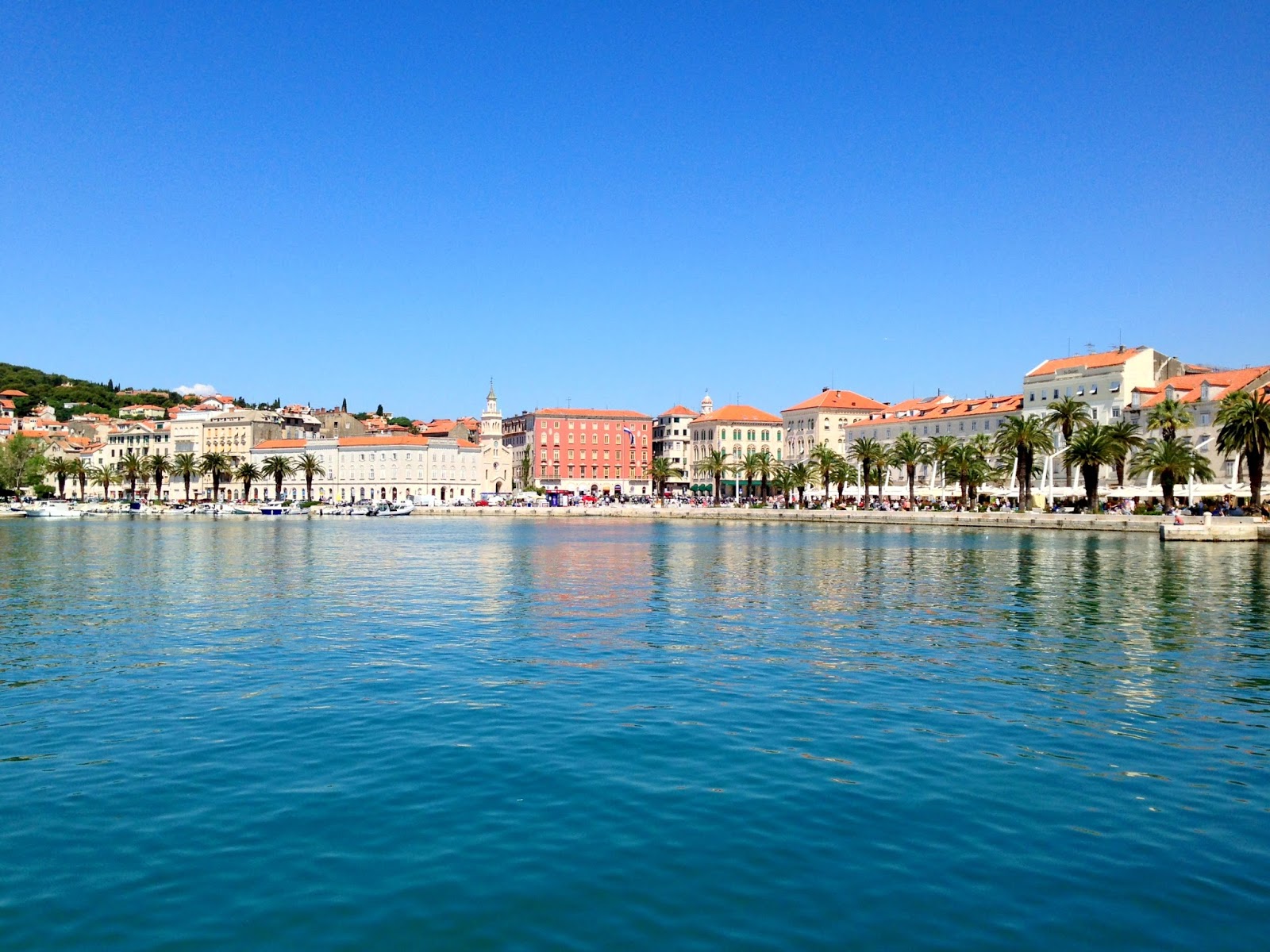
Yesterday (Sunday, May 31), Katya and I slept in a bit but still managed to have breakfast, pack and be out on the streets by 10 a.m.  It was a sunny and warm day on the Adriatic Coast.  Although there were a few museums we could have visited in Split, we decided that Sunday was our day for rest (which we need!) and spent almost the whole day strolling around Diocletian's Palace and the waterfront.

Split Waterfront
The first thing we did was climb the steps to the top of the bell tower for a panaramic view of Split.  The first few flights of stairs were the original (or duplicates of) ones from centuries ago, and these the risers were quite high.  Luckily, a bit further up, metal stairs were in place that seemed to have the normal heighth for risers.  We were fortunate that it was a cloudless day; the vistas were spectacular.

Shadow of the Bell Tower on the Peristil at Diocletian's Palace
After a short walk on the waterfront--strolling on the waterfront seems to be a favorite past-time of the locals--which allowed us to escape from the large tour groups (A cruise ship had come into port in the night.), we returned to the center of Diocletian's Palace to watch the changing of the guard.  Men dressed like centurians (reminding us of Octavius in Night at the Museum) responded to trumpet calls from a balcony.  Not as well-disciplined or precise as the Hungarian Parliament Guard, they took their places prior to the appearance of Diocletian and his wife, who greeted the crowd and welcomed everyone to split.  They took a more menacing (but hilarious) stance when the crowd did not respond enthusiastically enough to Diocletian's greeting.

Roman Guards
Our next stop was the main cathedral in Diocletian's Palace.  It was built after the 4th Century on the site of Diocletian's tomb.  Considering that Diocletian was not a Christian and had his wife and daughter killed for converting, he must be turning over in his grave!  Another irony was found in Jupiter's Temple, a small, square building not far from the main palace.  When we went inside, we did not find any statues or altars to Jupiter.  The Christians had long ago converted this Roman temple to a temple to St. John, and it is his statue which dominates in this building.  However, the coffered ceilings and other parts of the structure still harken back to pre-Christian Roman times.

Split Cathedral
Emaciated St. John in Jupiter's Temple
As in most of the places we have visited, layers of history can be found, from pre-historic through modern time.  Among all the preserved edifices and artifacts, daily life goes on, with shops, hotels, restaurants, sidewalk cafes, as well as homes, grocery stores and schools, using the historic structures.    One thing we really enjoyed was sitting on the steps along the Peristil and listening to phenomenal choral music being sung in the domed verstibule by various choral groups who happened to be touring in the area and must have heard about the wonderful acoustics.  Also, it was quite fun to escape from the bustle of the main plazas and explore the alleys.

Alley with Roman arches in Split
We walked quite a distance along the waterfront in both directions.  To the west of the old town of Split is a large yacht marina, with vessels of various sizes and values.  To the east lie the ferry and cruise ship terminals.  In the center of the waterfront, there are cafes, benches, grassy areas and a wide promenade.  We spent a great deal of time here.

Sailing, Split
Eventually, we were worn out well before it was time to catch the 10 p.m. train to Zagreb en route to Austria.  We had stored our luggage at the hotel--which was such a welcoming place that we hated to leave.  I went back to get a book to read.  (Katya already had her Nook with her.)  The man at the desk invited us to relax on the comfortable sofas in the lobby, an offer we couldn't refuse.  After an hour or so, we had enough energy to venture out to find food for dinner and stroll a bit more.

Katya on the waterfront
For our overnight journey, this time we booked couchettes in the sleeping car.  They were comfortable, but Katya was too cold and my back was in pain from too much exertion, so neither of us slept well.

Our plan had been to go to Ljubljana, Slovenia, for a day, but we decided to go for a bigger city, so we picked Graz, Austria, a city we really knew nothing about other than it being larger the the capital of Slovenia.  We were told in Zagreb that there was a direct night train to Salzberg, which we planned to take, but in Graz, we discovered that we would have to take two trains and spend an hour waiting between trains at a station in the country in the middle of the night.  Quickly, we adjusted our plans and booked a room for the night at a hotel very close to the Graz Hauptbahnhof (train station).  After we checked in, we set off to explore.

Like Dubrovnik and Split, the heart of Graz is a UNESCO World Heritage Site.  The range and quality of architectural styles is stunning.  Of course, we stopped in as many churches as we could.  (Katya has gotten used to this and doesn't complain.)  The first one we entered was the Barmherzigenkirche on the west side of the Mur River which runs through the city.  Painted yellow and trimmed in white on the outside, with Baroque ornamentation, the church's exterior does not hint at the glorious Baroque style that lies within.  Intriquately carved surfaces, rich-hued paintings, and gilded statues and decorations vie for attention within the sanctuary.

Baroque interior of the Barmherzigenkirche 
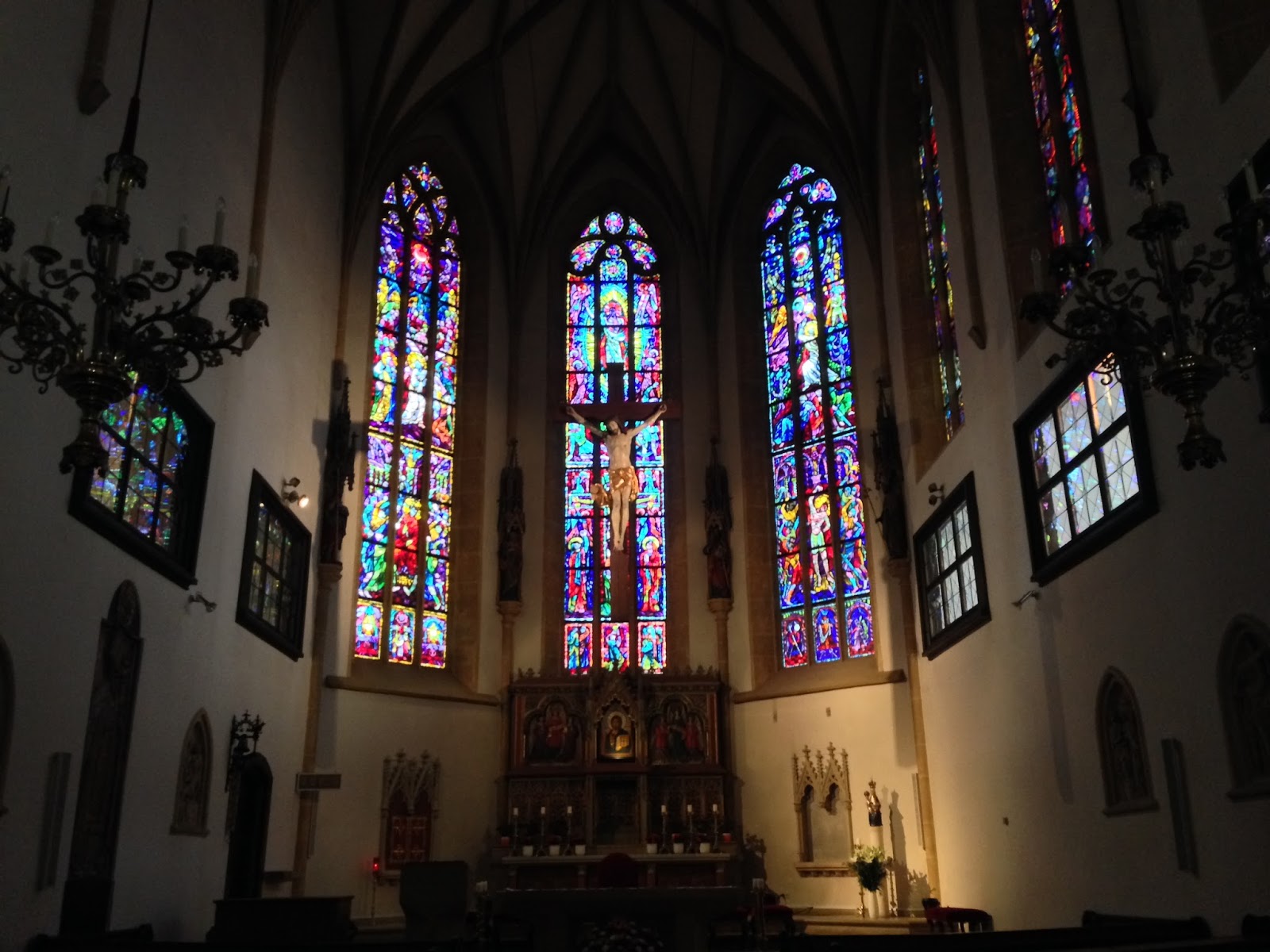
Crossing the Mur River, we encountered the church of the Franciscan Monastery.  Once again, we entered into a jewel, with the sun through gorgeous stained glass windows throwing luminous colors on the shiny floors.  We also walked around the quiet cloister and visited a small chapel off of it.

Stained glass windows in the Franciscan Monastery Church
From the sacred to the secular we went, arriving in Hauptplatz, the main town square, surrounding by facades of various architectural styles and dominated by the enormous, ornate Town Hall at the southern end.

Graz Town Hall
Local shops and chain stores abound around the square and on the streets radiating out from it.  We strolled down Herrengasse to see some of the most striking edifices, including one known as the Painted House.  The frescoes dating from the mid-18th Century depict Greek and Roman gods.

Painted House
A few block down the street, we shopped at H&M for shorts for Katya and then went into the City Parish Church, the Stadtpfarrkirche.  The outside is Baroque in style, but the interior is both Baroque and Neo-Gothic.  (It originated as a Gothic church.)

Stadtpfarrkirche
The next church we visited, after grabbing a snack on the street, is the oldest parish church in Graz, dating from the mid-15th Century.  Enclosed within a former Augustinian monastery, the Stiegenkirche can be found up a couple flights of stairs.  Unlike anything else we have seen on this trip, the interior is plain and modern.

Stiegenkirche
Leaving this church, we started the ascent to the Schlossberg, a large, quiet, tree-filled park on a hill where a small fortress and castle were built over 1000 years ago.  This fortification was extended into a huge Renaissance fortress in the 16th Century.  Unfortunately, not many of the fortifications are left, but the bell tower and the clock tower were saved from destruction by aggressors by the citizens of Graz.  The clock tower is the traditional landmark of the city and can seen from many vantage points.

Schlossberg Clock Tower
The bell tower, further in the park, was built in 1588, and houses Graz's most famous bell, named Liesl.  The remains of gates, cannon bastions,  a powder house, prisons and a well lie throughout the expansive park.  A beautiful formal garden can be found on a plateau below the clock tower.  There are many paths to and through the park.  We left the park after walking through the formal garden, by descending 260 steps through the hillside Herbersteingarten, a series of terraces that was built and planted with Mediterranean plants between the two world wars.

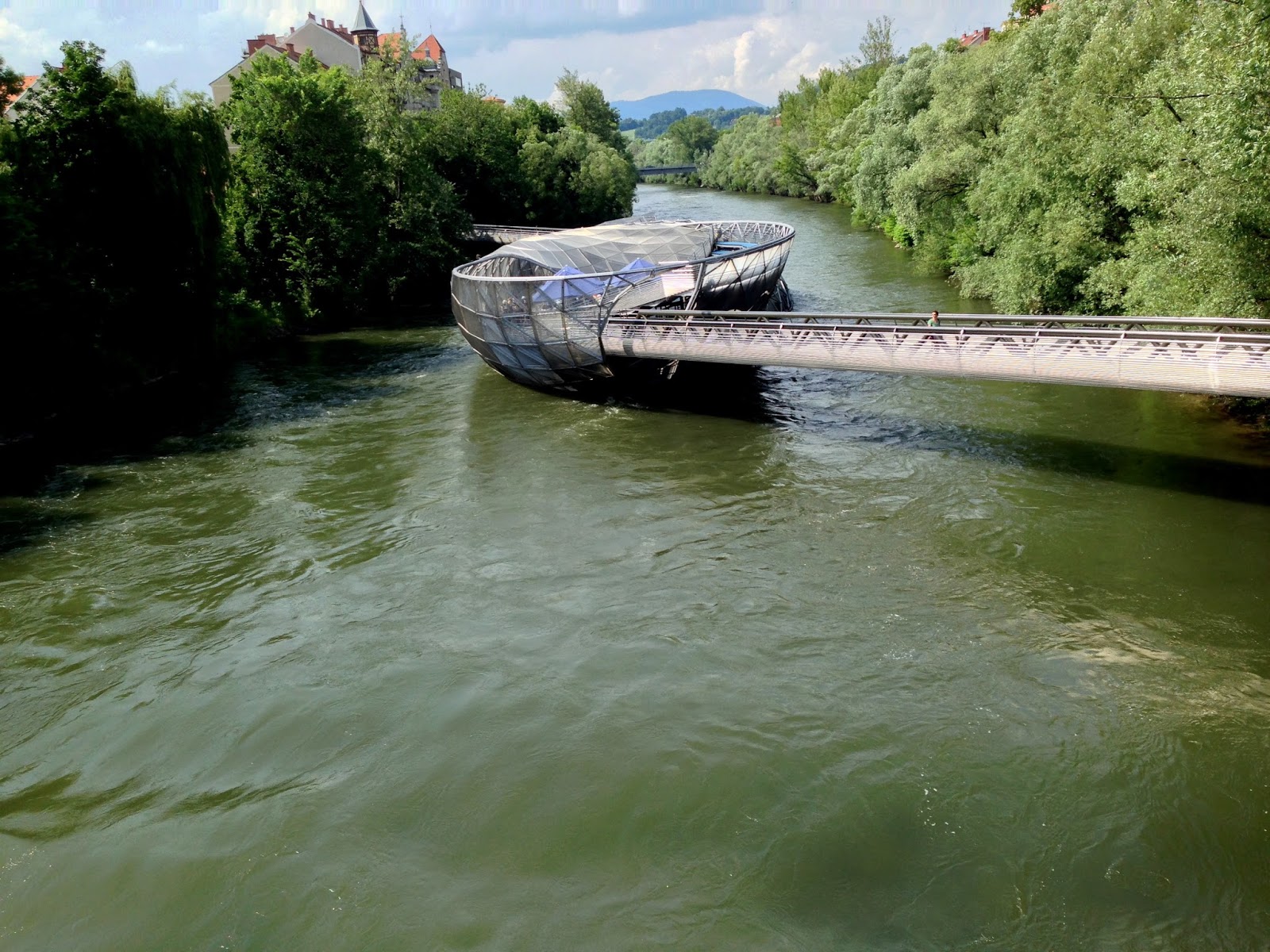
We crossed back over the Mur River by the footbridges which connect to the Murinsel, a distinctive floating shell housing a cafe and an amphitheater in the middle of the rapidly flowing stream.

Murisel
This took us to Mariahilferplatz and the 17th Century Mariahilferkirche, yet another wonderful Baroque sanctuary with adjoining cloisters and monastery.  Particularly striking are the large crystal chandeliers.
Chandeliers in Mariahiferkirche
Katya and I both agreed that our feet could not endure any more walking, so we got dinner and came back to the hotel well before sunset.  In the morning, we catch a train at 5:45 a.m. for Salzburg, where we will spend one night.

We are truly enjoying our time together.  We love the architecture and style of Europe, and almost everyone has been extremely friendly and helpful.  We could do with less cigarette smoke and I would enjoy ice in my drinks, but who's complaining?  Not us!  We feel so lucky to be having this wonderful experience.